Targets & strategy
Lenzing’s sustainability strategy & targets
Targets & strategy
Our sustainability strategy, “Naturally Positive,” is guided by three strategic principles. It focuses on the areas where Lenzing has the most significant impact – such as climate action, resource use, and responsible production – supported by defined targets, ongoing investments, and continuous process improvements.
This framework also guides Lenzing’s contribution to the United Nations Sustainable Development Goals (SDGs), aligning business activities with internationally recognized sustainability priorities.
Sustainability strategy
Our sustainable strategy
FOCUS AREAS
Our strategic focus areas
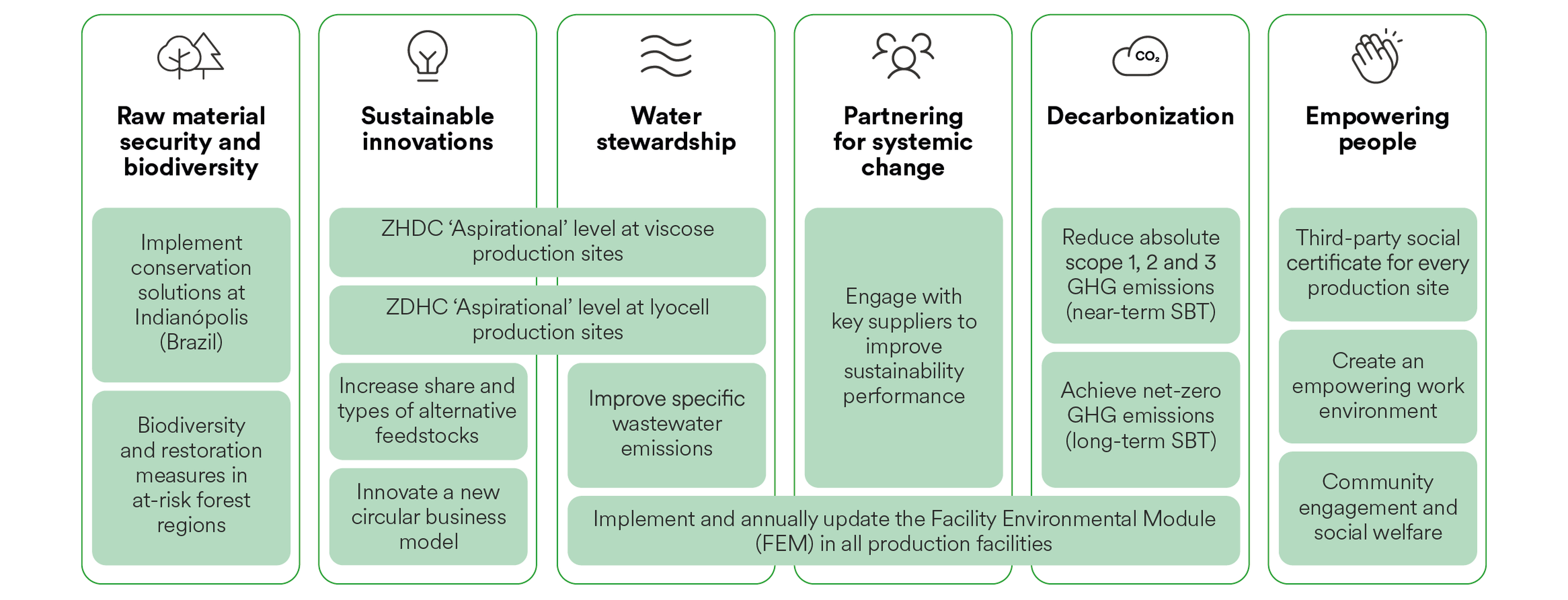
Raw material security
Wood and dissolving wood pulp, along with process inputs, are key raw materials for Lenzing. Responsible sourcing is supported by structured supplier management and defined procurement standards. These include supplier selection based on certification and risk assessment, ongoing monitoring of sourcing practices, and alignment with recognized forest certification systems (such as FSC™ or PEFC). Lenzing applies defined wood and pulp sourcing standards to avoid sourcing from controversial or high-risk regions. The company focuses on using raw materials efficiently and continuously improving sourcing practices to support reliable supply and responsible production.
Water stewardship
Water is a valuable resource, and responsible water management is an integral part of Lenzing's production processes. The company continuously works to reduce water use and improve water quality through process optimization and advanced treatment systems. Environmental impacts on water are managed through controlled processes and compliance with defined standards. In addition, Lenzing develops fiber solutions that can help reduce water consumption in downstream processing, supported by life cycle assessment (LCA) results. Lenzing fibers are certified as biodegradable and compostable under defined conditions (including industrial, home, soil, and marine environments).
Sustainable innovations
Innovation is a key driver of how Lenzing improves its processes, products, and business models. The company focuses on developing fiber solutions, optimizing production technologies, and advancing circular and low-impact approaches across its operations. This includes investments in research and development, continuous process improvements, and the integration of sustainability criteria into innovation activities. These efforts are reflected in areas such as energy and resource efficiency, recycling technologies, and product development. Sustainable innovation is embedded across Lenzing’s core business areas and is supported by defined targets, performance tracking, and ongoing technology upgrades.
Empowering people
People are at the centre of change. Lenzing supports this by creating an environment where employees can take responsibility, contribute ideas, and develop their skills. The company promotes fair and respectful working conditions through clear policies, training programs, and regular assessments. This includes commitments to human rights, health and safety, diversity and inclusion, and responsible business conduct across its operations and partnerships. Lenzing also engages with partners along the value chain to encourage responsible practices and continuous improvement.
Partnering for systemic change
Only by acting in partnership can we address the complex challenges of sustainability. A high level of transparency enables us to build trust with our partners in the long term. This is the prerequisite for a regular exchange of ideas and basis for uniting different points of view, understanding global trends and reducing risks. For example, Lenzing works on cross-industry business models designed to promote the circular economy.
Enhancing community wellbeing
Lenzing contributes to the economic and social development of the communities and regions in which it operates. This includes supporting safe and environmentally responsible operations and fair employment practices. Lenzing's global activities support more than 25,000 jobs, including direct employment and jobs created in related sectors.
Our contribution to climate protection
Addressing greenhouse gas emissions is a key focus area for Lenzing. The company has defined science-based targets and has set a target of net-zero greenhouse gas emissions by 2050 according to SBTi definition. This includes measures such as improving energy efficiency, increasing the use of renewable energy, and optimizing production processes to reduce emissions over time.
TARGETS
Lenzing raising the bar – our sustainability targets
Within its sustainability strategy, “Naturally Positive,” Lenzing defines key focus areas addressing its environmental and social impacts. These areas are supported by defined targets, implemented through operational measures, and monitored on a regular basis. The focus areas are aligned with selected United Nations Sustainable Development Goals (SDGs), including climate action, responsible consumption and production, and decent work. Detailed information on targets, implementation measures, and progress is available in Lenzing’s Annual and Sustainability Report.
SDGs
Lenzing’s contribution to the UN Sustainable Development Goals
No poverty
Lenzing contributes through social impact projects that support rural development and alternative income opportunities. For example, sustainable agriculture and agroforestry initiatives support small-scale farmers by improving productivity, strengthening climate resilience, and creating new income sources.
Good health and well-being
Lenzing provides occupational health services at its production sites, complemented by partnerships with regional healthcare providers. These include preventive programs and site-specific health services adapted to local conditions.
Gender Equality
Lenzing promotes diversity, equity, and inclusion through internal programs, including training, employee initiatives, and targeted action plans. Some development projects also include gender-related measures, such as gender analysis and implementation plans.
Clean water and sanitation
Lenzing manages water use and discharge through defined targets and operational measures. This includes reducing wastewater emissions and investing in treatment infrastructure and process improvements across production sites.
Affordable and clean energy
Lenzing contributes by improving energy efficiency and applying energy recovery solutions in its production processes. Additional measures include optimizing energy use and adjusting energy sources where technically feasible.
Decent work and economic growth
Lenzing contributes to local economies through its production sites and supply chains. According to an economic impact study covering 2023, the company’s global activities support more than 25,000 jobs, with each direct job creating additional employment in related sectors.
Industry, innovation and infrastructure
Lenzing’s innovation activities focus on improving production processes, increasing resource efficiency, and developing new fiber solutions. Sustainability criteria are integrated into research, development, and operational improvements.
Reduced Inequalities
Lenzing applies policies on human rights and labor standards across its operations and value chain. These include commitments to non-discrimination, fair working conditions, and regular assessments of internal and external practices.
Sustainablie Cities and Communities
Lenzing engages with communities near its production sites through long-term initiatives. Activities include environmental programs, education, and local development support. For example, at the Purwakarta site, initiatives include waste management programs, environmental awareness campaigns, and community training to improve local livelihoods.
Responsible consumption and production
Lenzing supports responsible production through efficient resource use, certified sourcing, and integrated production concepts such as biorefineries. Recycling technologies and collaboration across the value chain contribute to more circular material use.
Climate action
Lenzing has defined science-based targets to reduce greenhouse gas emissions and aims to achieve net-zero emissions. Measures include improving energy efficiency, increasing the use of renewable energy, and optimizing production processes.
Life below water
Lenzing develops fibers that are certified as biodegradable under defined conditions. This helps reduce the persistence of materials in aquatic environments compared to non-degradable alternatives.
Life on land
Lenzing supports biodiversity and ecosystem protection through conservation and restoration projects. These include reforestation, afforestation, and sustainable land management initiatives implemented in cooperation with local communities and partners.
Peace, justice and strong institutions
Lenzing collaborates with stakeholders across the value chain, including NGOs, development organizations, and industry partners. Many initiatives are implemented through multi-stakeholder partnerships that combine environmental and social objectives.
Partnerships for the goals
We are convinced that complex global challenges require a cooperation approach. For this reason, the Lenzing Group regularly exchanges views with a large number of stakeholders and business partners along the value chain, in order to further raise standards with respect to sustainability in the textile and nonwovens industry.